The Islamic regime of Iran, following the massacre of the bloody January 2026 protests and the brutal killing of demonstrators, is today, under the shadow of war, continuing its crimes in the most ruthless manner. Like a wounded snake, it has turned on the people.
This despised regime, by continuing its nuclear and warmongering policies, is dragging people’s lives and all the infrastructure of society toward total destruction. By refusing a ceasefire and negotiations—despite suffering severe and devastating blows—it seeks to drown society in blood under the cover of war and preserve its existence at any cost.
In line with this policy, the government is carrying out merciless suppression and crimes, and executions have become a daily occurrence. Inside prisons, a humanitarian catastrophe is unfolding. Protesters, like prisoners of war, are under hunger pressure and subjected to torture and harassment, with their lives in grave danger. Cities have been fully militarized, with patrols and street checkpoints established. By deploying thugs and militants from groups such as Hashd al-Shaabi, Fatemiyoun, and Zeynabiyoun, and parading them through the streets, the regime sends a message of death and repression to the people.
Gholamhossein Mohseni-Ejei, the head of the judiciary and commander of executions and repression, on April 6 ordered the acceleration of verdicts against “collaborators with the enemy”—meaning protesting citizens—and emphasized no delay or leniency. In the same speech, he once again stressed the law intensifying punishment for “espionage and cooperation with Israel and hostile countries,” which serves as a code for opposition to the regime. He threatened protesters inside Iran and Iranians abroad with execution sentences and confiscation of property under accusations of “intelligence activities or espionage in favor of Israel or hostile governments.” According to reports, arrests have expanded under this policy, and many protesters have been detained under these charges and face the risk of execution.
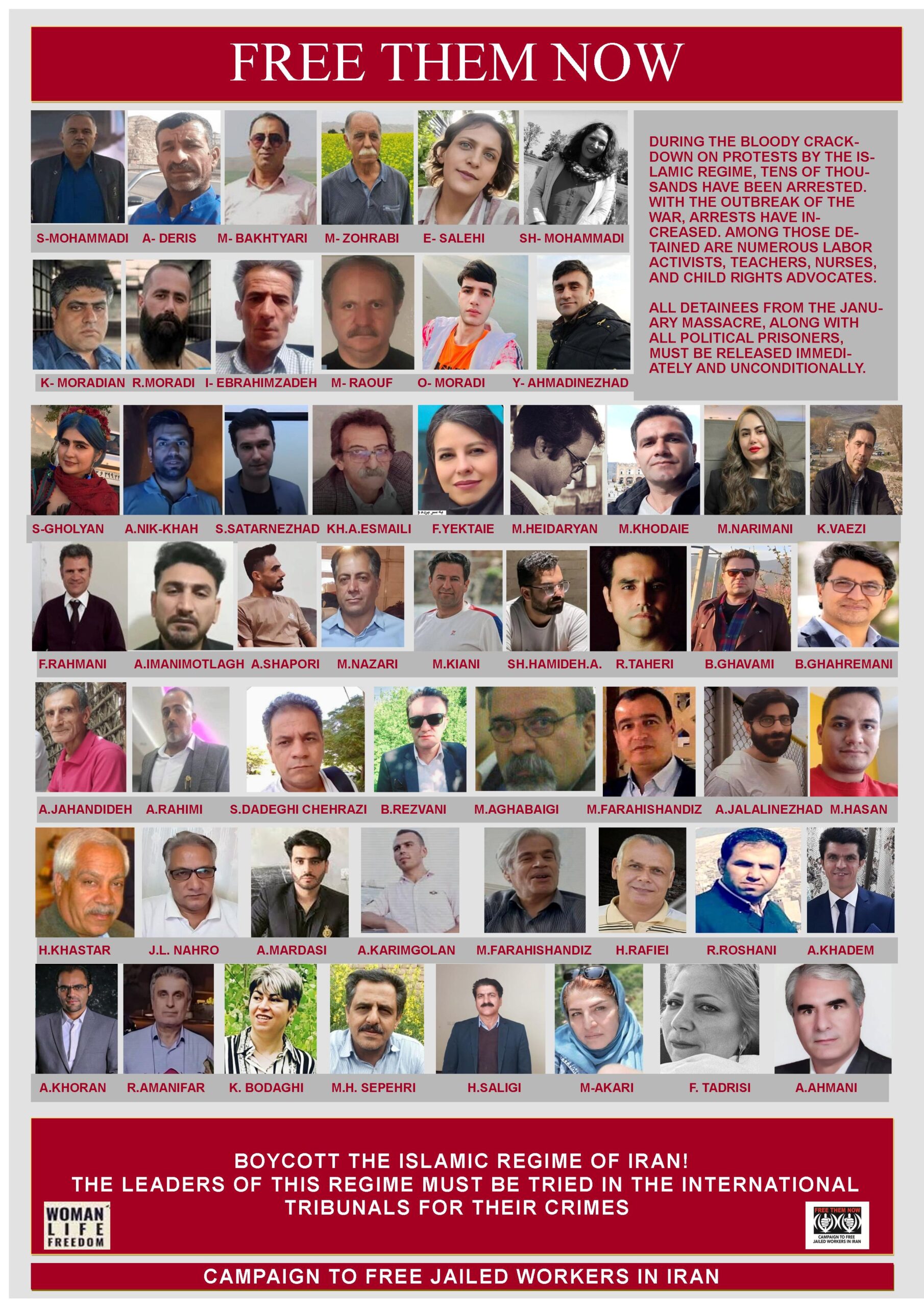
Given the important role of the Coordinating Council of Teachers’ Trade Associations—particularly in organizing campaigns such as “Empty Desks” and “Classes Without Teachers” in protest of the January killings, which gained global attention—security threats and arrests of teachers have intensified. The arrest of Reza Amani-Far, inspector of the council and member of the Bushehr Teachers’ Association on April 4; the arrest of Bakhtiar Rezvani, a protesting teacher in Gachsaran on March 7, who had gone to follow up on his brother Khashayar Rezvani’s situation; and the continued detention of Manouchehr Aghabeigi, board member of the Kermanshah Teachers’ Association since March 17, are recent examples.
Reports also indicate the arrest of more than 30 protesters in Kermanshah and 28 in Sistan and Baluchestan on April 6. According to official reports, 13 of these individuals are accused of facilitating the entry of groups into the country, 10 of “network-building” and forming operational cells, and 5 of media activity and sending information about military, defense, and economic centers. It has also been claimed that weapons such as Kalashnikovs, handguns, explosives, and communication equipment were discovered. These accusations serve as a prelude to issuing death sentences against these protesters.
Furthermore, according to reports on April 6, four political prisoners—Saeed Masouri, Loghman Aminpour, Meysam Dehban-Zadeh, and Sepehr Emam-Jomeh—who began a hunger strike on March 29 in protest of the transfer of six death-row political prisoners for execution, are still being held in solitary confinement in Ward 4 of Ghezel Hesar Prison.
News of these arrests and repressions has received global attention. The United Nations Fact-Finding Mission has warned about the execution of political prisoners and unfair trials in Iran. In its report, it described the use of the death penalty as a tool to suppress opposition as a serious violation of human rights, condemned the executions, and called for their immediate halt.
The movement against prisons and executions in Iran has today become an international movement—one end rooted in prisons and the other across the world. A global campaign against executions and in support of political prisoners has formed with three urgent demands: the immediate halt of all executions and abolition of the death penalty; the immediate release of all detainees and political prisoners; and immediate access for the people of Iran to free internet. This campaign includes dozens of organizations, groups, and political parties.
At the same time, the “No to Execution Tuesdays” campaign—held through weekly hunger strikes by prisoners—reached its 115th week on April 7 and was active in 56 prisons across the country.
Despite wartime conditions, internet shutdowns, and communication restrictions, this campaign continues to expand. Participating prisoners have announced that they remain committed to the “No to Execution Tuesdays” campaign and will continue their hunger strikes.
Free Them Now, the campaign to free jailed workers in Iran, emphasizes on the united struggle of all workers unions, social organizations, associations, political parties, and movements to confront the regime’s widespread repression, executions, and killings.
Free Them Now
April 7, 2026